
On Sunday 27 September, the new EU greenwashing rules start to apply across the Union. Their formal name is Directive (EU) 2024/825, on empowering consumers for the green transition. In plain terms: from that date, a sentence sitting on thousands of hotel pages right now can break the law. Moreover, you don’t have to be a large company, because there is no size threshold here. There is no new regulator either. This is consumer law, and the same authority that has always policed misleading advertising will enforce it.
What the EU greenwashing rules ban, in four sentences
1. Vague words with nothing behind them
“Eco”, “green”, “environmentally friendly”, “sustainable” on its own. You can keep using them, but only if you can demonstrate recognised excellent environmental performance. In other words, a hotel advertising itself as “eco accommodation” with nothing to show has a problem. By contrast, one saying “100% of our electricity comes from a certified renewable supply contract” does not.
2. Labels that aren’t labels
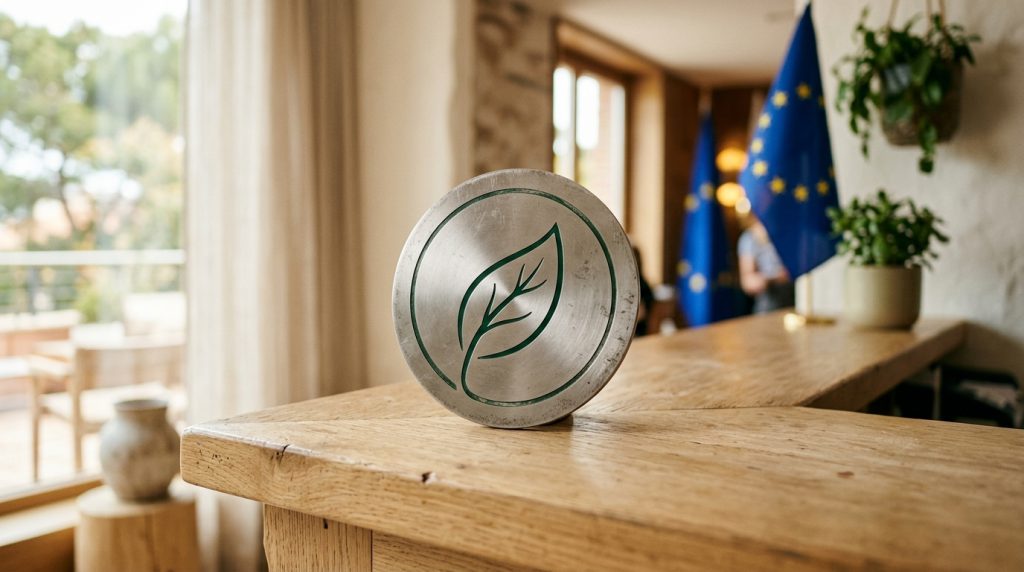
You can no longer display a sustainability label that rests on no certification scheme. The same goes for any label that no public authority established. Consequently, green leaves, self-awarded icons and a platform’s in-house “recognitions” all fall here.
3. Selling neutrality you bought
This is the one that matters most to travel. You cannot claim a product or service has a neutral, reduced or positive impact in emissions terms on the basis of offsetting. In other words, “climate-neutral flight” and “carbon-zero stay because we plant trees” are gone. However, you can still communicate real, measured reductions. Mention offsetting separately, and never call it neutrality.
4. The part standing in for the whole
You also cannot make an environmental claim about an entire business when it actually concerns one specific aspect. Swapping the plastic bottles in the bathroom does not make the hotel sustainable. Moreover, one detail catches a lot of people out: you cannot present something the law already requires as a distinctive feature.
What the run-in has already taught us
Here is the useful part, because none of this starts from scratch on the 27th. In fact, the cases have been arriving for two years, and national authorities decided them under consumer law that already existed. Therefore the directive doesn’t invent the standard — it writes it down and gives it a date.
Booking.com, March 2024
The Dutch consumer authority (ACM) found its “Travel Sustainable” programme misleading. The problem wasn’t only the scoring. The name implied that travelling is sustainable, the green leaf reinforced it, and nobody could tell what the score measured. Moreover, the ACM noted that EU law already requires some of the rewarded measures, such as removing single-use plastics. Booking pulled the badge worldwide, at a point when more than 500,000 properties carried it. It then replaced the badge with a filter for third-party certification, which is precisely what the new rules now ask of everyone.
KLM, March 2024
The Amsterdam District Court found 15 of the 19 claims in its “Fly Responsibly” campaign misleading. They gave the impression that flying with the airline was, or was about to be, sustainable. However, the measures announced barely moved the needle.
Twenty-one airlines, 2024
The European Commission and the network of national consumer authorities (CPC) acted against the environmental claims of twenty airlines. All of them ended up committing to stop saying that a passenger contribution could neutralise a specific flight’s emissions. Nor will they sell it as direct offsetting through climate projects or alternative fuels. A year later, in March 2025, the Cologne Regional Court barred Lufthansa from advertising its “Green Fares” with a promise to offset the flight’s emissions.
The lesson, if you keep only one
The sentence that gets you into trouble is almost never the technical figure in the report. It’s the headline on the homepage.
In brief
- Spain is running late. The transposition deadline expired on 27 March 2026 and the intended instrument — the draft Sustainable Consumption Act — has yet to clear parliament. According to analysis by law firm Ferrer-Bonsoms & Sanjurjo, the Commission opened an infringement procedure in May 2026. Even so, the sector is not in a no man’s land: existing Spanish unfair competition and consumer protection law already covers misleading claims. In fact, courts and regulators decided the KLM and Booking cases under exactly that kind of law, before this date existed.
- Don’t confuse them with two other rules. The EU greenwashing rules are not the CSRD, and not the future Green Claims Directive either. CSRD governs what a large company reports to investors and regulators, and it has thresholds: since March it reaches only around 5,000 European companies. By contrast, this one governs what any company tells a customer while selling to them, and it has no threshold at all. Consequently, an eight-room rural hotel sits outside CSRD and squarely inside this. The third, the Green Claims Directive, remains a separate proposal that nobody has adopted.
- It covers what you didn’t write. Your property’s claims don’t only live on your website. They’re also in your OTA listing, your confirmation email footer, the signs in the rooms and the names of your rates. For example, a rate called “Green Rate” is an environmental claim.
How to get ready for the EU greenwashing rules
This week’s tip: a 20-minute review before the 27th
- First, search your site for “eco”, “green”, “sustainable” and “responsible”. For each one, ask whether you can show the figure behind it. If not, replace the word with the figure.
- Next, check your icons and leaves. If a label doesn’t come from a certification scheme or a public authority, take it down.
- Delete the word “neutral” from any sentence resting on offsetting. Instead, state what you reduce with a number and mention offsetting separately.
- Make sure as well that no specific improvement reads as if it described the whole business. And that you’re not selling as a merit something the law already requires.
- Finally, run the same sweep across OTA listings, rate names, social media and automated emails. That’s where the sentences nobody remembers writing live.
One note, because it’s always the next question. If certification becomes the safe ground, it matters which schemes someone genuinely audits and which are a logo you can buy. We go into it in our series on sustainable tourism certifications.
At this world to book we have only ever worked with accommodation holding recognised certification. Consequently, 27 September changes nothing for us, which is exactly the point. Start your search here.
— the this world to book team
Sources: Directive (EU) 2024/825 (text in the Official Journal), European Commission, Netherlands Authority for Consumers and Markets (ACM), Amsterdam District Court, Cologne Regional Court, the CPC network of consumer authorities, Spain’s Ministry of Social Rights and Consumer Affairs, and Ferrer-Bonsoms & Sanjurjo Abogados.