
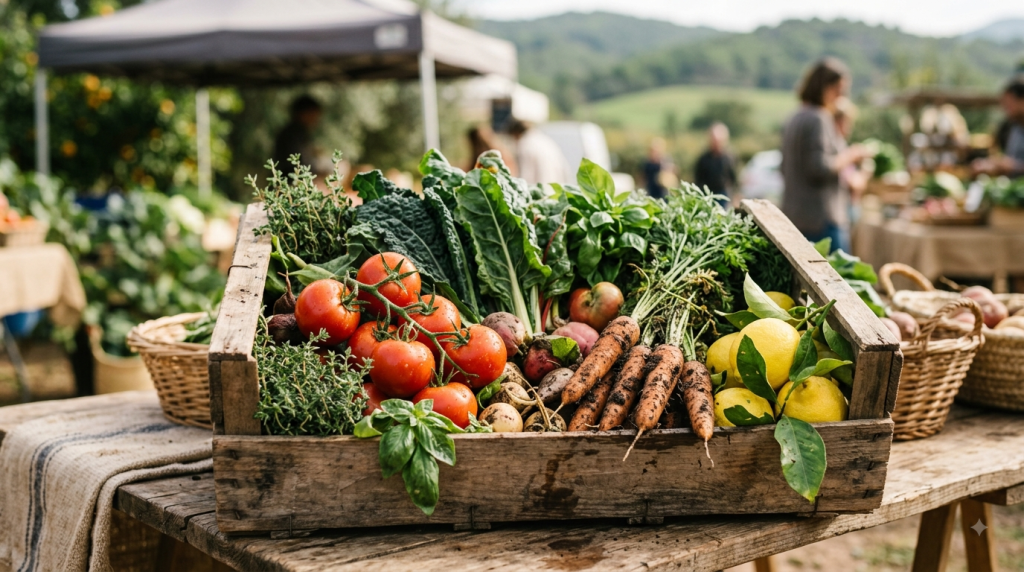
On August 7, the Basque Government quietly amended a regulation: farmers growing organic Gernika pepper can now use the same Protected Geographical Indication label as everyone else. It’s small news, but it points to a much bigger question about the real organic food impact at scale. According to The World of Organic Agriculture 2026, the annual survey from Switzerland’s FiBL institute and IFOAM – Organics International, organic farming is now practised in more than 180 countries, on nearly 99 million hectares, by at least 4.8 million farmers.
So does any of that actually change anything? Below, we walk through what’s genuinely settled by science, what’s still debated, where organic food shows up, and where the story is already moving next: regenerative agriculture.
The Global Organic Food Impact, Region by Region
The picture isn’t uniform. Here’s what’s interesting:
- Europe is the biggest consumer market by habit and regulation. It contributes heavily to the €145 billion global organic food and drink market in 2024 (+€6.9bn on 2023).
- The United States alone accounts for €60.4 billion of that total — the single largest national market.
- Australia has the largest organic farmland area of any country. Meanwhile, Liechtenstein has the highest share of its farmland under organic management.
- Latin America posted the fastest area growth of any region recently: over 10% in a single year.
- Africa shows the most dynamic growth in farmer numbers. However, almost none of it is formally certified: just ~0.2% of Africa’s organic land carries certification. Most smallholders farm organically by default and rely on IFOAM-backed Participatory Guarantee Systems instead.
Fruit Bowl Yes, Steak No: Where Organic Actually Shows Up
Not every organic product sells or grows at the same pace. Market analysts consistently describe the same pattern, even when their total-market estimates differ:
| Category | Where it stands | Why |
|---|---|---|
| Fresh fruit & vegetables | Clear leader — roughly 30–35% of global organic food sales | One crop is simple to certify; the price premium is easy to justify on fresh produce |
| Dairy | Second-largest segment | Established supply chains, strong consumer trust |
| Packaged & processed goods | Fastest-growing segment | Retailers are rolling out private-label organic ranges at scale |
| Meat, poultry & fish | Lowest penetration almost everywhere | Certifying an entire feed chain is slow and costly; the price gap is widest here |
These shares come from commercial market-research firms, not peer-reviewed sources. Different providers report different totals. Even so, one figure is consistent across sources: organic products are often roughly twice the price of their conventional equivalent.
Regionally, North America is currently the largest organic market by value. Europe leads on regulatory infrastructure and consumer trust. Asia-Pacific, led by China, Japan, India and Australia, is growing fastest.
Does It Actually Work? The Organic Food Impact, Verdict by Verdict
This is where most articles either oversell organic food or dismiss it outright. The honest picture is more interesting than either:
| The claim | What the research shows |
|---|---|
| “Organic food is more nutritious” | No strong evidence for a blanket claim, per a 2012 Stanford meta-analysis (~240 studies). However, a larger, later review — Barański et al. 2014 (343 studies) — found organic crops carry 20–40% more antioxidant polyphenols. It’s unproven whether that changes real health outcomes. |
| “Organic food has fewer pesticides” | Confirmed. Residues appear four to five times more often in conventional produce. Cadmium levels run ~48% lower in organic crops. |
| “Organic farming yields less food” | Confirmed. A 2012 Nature meta-analysis found yields average 19–25% lower. The gap nearly disappears for legumes and perennials under best practice. |
| “Organic farming is better for soil” | Mostly confirmed. A 2012 meta-analysis found 7% higher soil organic matter and more biodiversity on organic farms. That said, emissions per unit of food produced run higher. |
In short: organic food’s strongest case is environmental and toxicological. Its weakest case is the blanket “healthier for you” claim. And its biggest structural problem, lower yields, is exactly what pushed agronomists toward the next step: regenerative agriculture.
The Next Chapter: Regenerative Agriculture
Organic and regenerative get used as synonyms, but they’re not the same ambition. Organic farming is built around not harming the soil. Regenerative farming goes further: it aims to actively rebuild soil that’s already degraded, often starting from depleted land. In practice that means no-till farming, permanent cover crops, rotational grazing, and agroforestry.

The Certification That Already Exists: Regenerative Organic Certified
The climate logic is straightforward soil physics: more organic matter means more water retention and more stored carbon. That’s the idea behind the international “4 per 1000” initiative, launched at COP21. There’s no EU-wide regenerative label yet. The US, however, has one: Regenerative Organic Certified (2017), built on three pillars most organic certifications don’t combine — soil health, animal welfare, and social fairness.
Spain, a Testing Ground
Spain is one of Europe’s more active testing grounds, and it happens to double as a travel story. Polyfarming, a project led by the CREAF research institute since 2016 on a once-abandoned estate in Planeses, Girona, has produced five years of evidence that regenerative techniques can restore degraded land. Familia Torres, for example, is converting its entire certified-organic vineyard portfolio to regenerative management, aiming to turn its vineyards into carbon sinks.
In Andalusia, the AlVelAl association is restoring eroded farmland using the same principles. The topic has also reached mainstream Spanish-language climate communication: Hope! – En pie por el planeta, led by Javier Peña with a scientific advisory board that includes CREAF and CSIC researchers, filmed a piece on regenerative agriculture at the Planeses estate itself. It’s a useful entry point for a general audience, though, like any single-farm case study, it illustrates the model rather than replaces the underlying research.
In Brief: Three More Stories on the Organic Food Impact
- HIP 2026 puts sustainable gastronomy at the centre of European tourism. European Commission representatives underlined the Farm to Fork strategy as a driver for reduced pesticide use.
- Denmark keeps setting the pace on organic food service. FiBL/IFOAM data shows sustained growth in organic consumption within Denmark’s restaurant sector since 2016.
- EcoGastronomía connects certified organic farms with rural stays in northern Spain. The network links ECEAT-certified holdings in Galicia and Asturias with rural accommodation.

💡 Tip for Conscious Travellers
Before booking an “organic” restaurant or stay, look for a specific certification. Ask where seasonal ingredients come from. A menu that changes with local production is a far more reliable signal than the word “eco” on a sign.
Want to understand what separates a serious certification from an unverified label? We break it down in our Certifications series, covering standards like GSTC, Ecolabel and Green Key.
What Do You Think?
At the positive trip, by this world to book, we track real progress in tourism sustainability to help you design experiences with genuine impact. If your property or destination works with certified organic or regenerative production, tell us: we’d love to feature your story. Explore more at thisworldtobook.com.